Rumination, second guessing everything, answering work related emails at midnight (when I didn’t have to).
Once I answered that email at midnight (which arrived way earlier than that), I knew it was time to call my doctor.
I set up a phone call, and we talked about my HRT and antidepressants.
It was decided that since there was room to move up on my antidepressants, we would go this route.
Tomorrow I start the new dose.
I’m hopeful this will work.
Perimenopause is doing me dirty and I am not a fan.
One thing I am grateful for is all the work I put in through therapy over the past few years to recognize when I hit my wall BEFORE it crumbles.
I’m not one to suffer in silence anymore. If I need help, I ask.
With the Fall ramping up and year end on its heels, I want to keep myself healthy mentally.
To help me physically, I need regular movement again. I have a bike (and it is a workout let me tell ya), taking marine collagen, and starting to consider yoga again.
Feeling like I am falling apart is no good, so one step at a time.
I have a follow up in two months.
As women, we really need to be louder about this stage of our life – and I am glad to see more of us out there speaking our truth.
When I started my new position, I was reading every single email about what was happening: events, charity work, training sessions, educational pathways, etc.
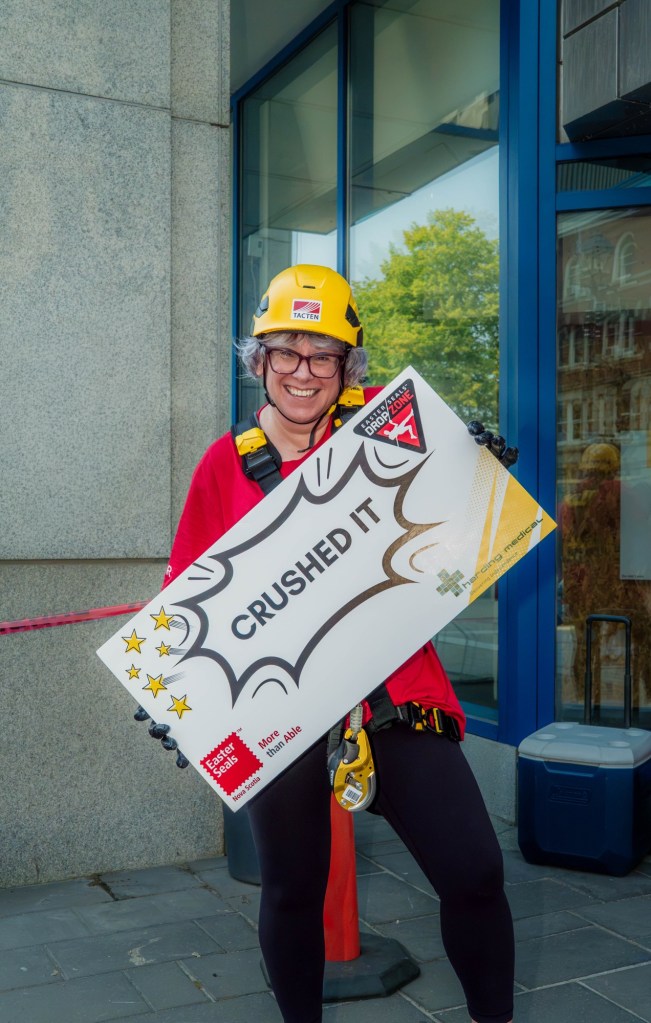
One day, I saw a call out for an Easter Seals fundraiser called Drop Zone.
I’m familiar with the event, knowing those who participated in the past. I was also aware of the good work that Easter Seals does for accessibility.
Accessibility is essential because it ensures everyone can participate fully, regardless of ability. When we design spaces, technology, and information to be inclusive from the start, we remove barriers that limit people’s independence, dignity, and opportunity. Prioritizing accessibility isn’t just a compliance checkbox—it’s a commitment to equity, innovation, and creating environments where all people can thrive.
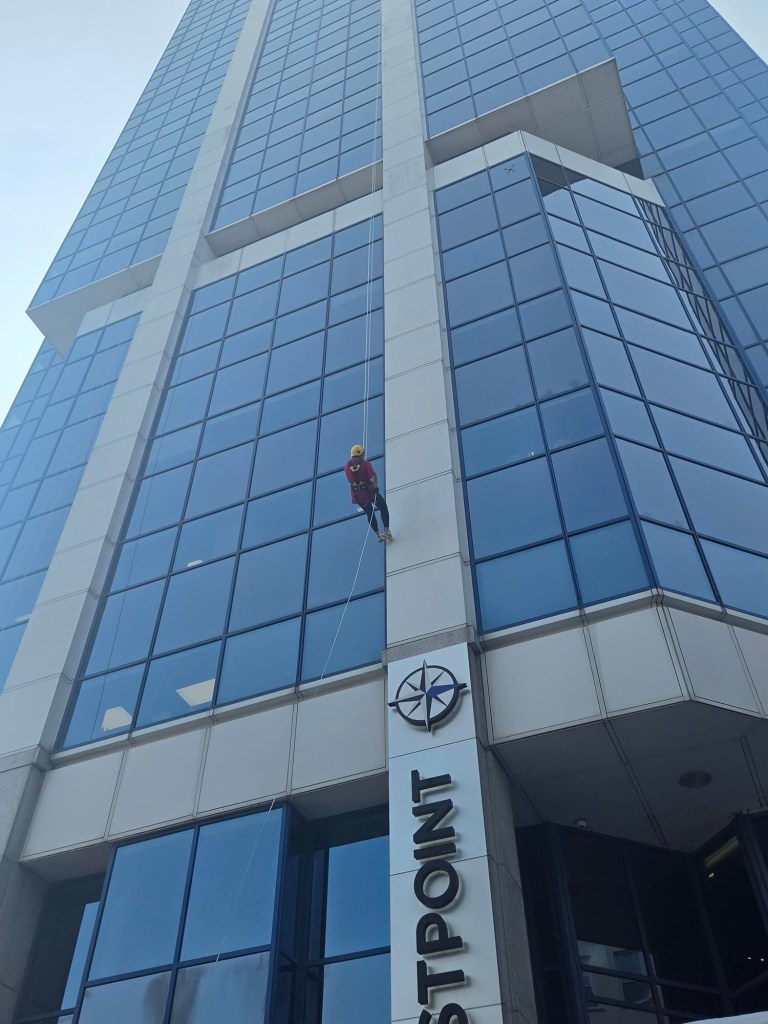
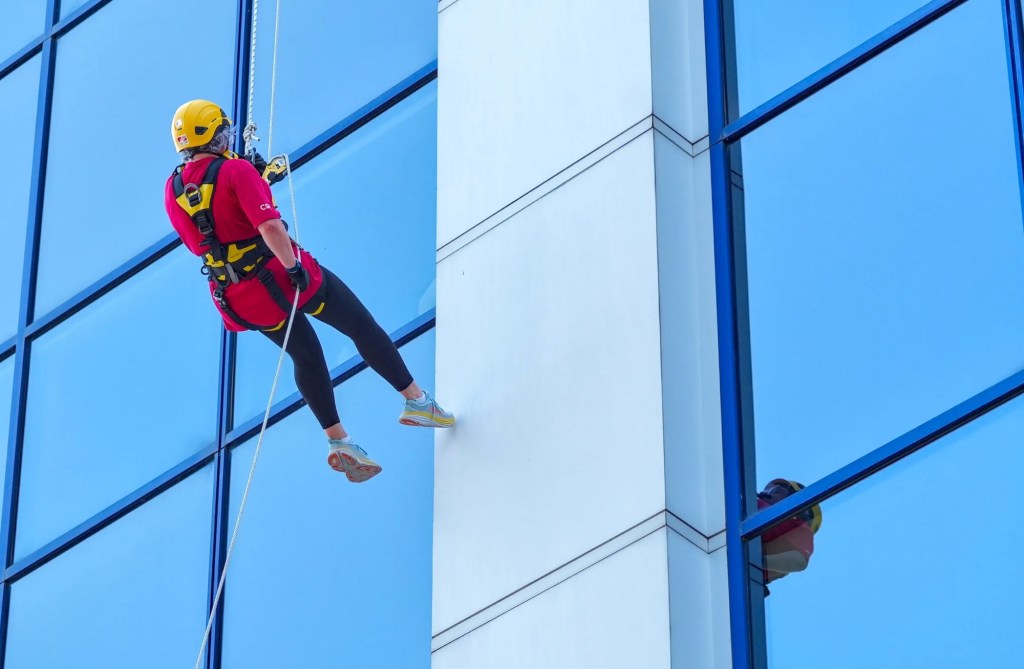
Drop Zone is a rappel event held across Canada. In Halifax, it is a 23 story rappel off of an office building.
It took me about a minute, and I asked to be signed up.
Now….
I have never rappelled.
I have been on theme park rides. You’re usually in a secure “vehicle” and “strapped in”. The ride is usually not long, and before you realize it, it’s over.
I’m not gonna lie…I have a slight fear of heights.
This event would pit me against one of my fears. It also would allow me to raise awareness about accessibility.
It seemed so far away when I signed up and started fundraising.
Then I had to sign up for rappelling sessions.
Then I took those lessons (the scariest part was sitting back) off of a half wall at a climbing gym.
I thought: “I got this!”
Reader: It was false bravado, lol.
Nothing was real until I reached the roof in my gear.
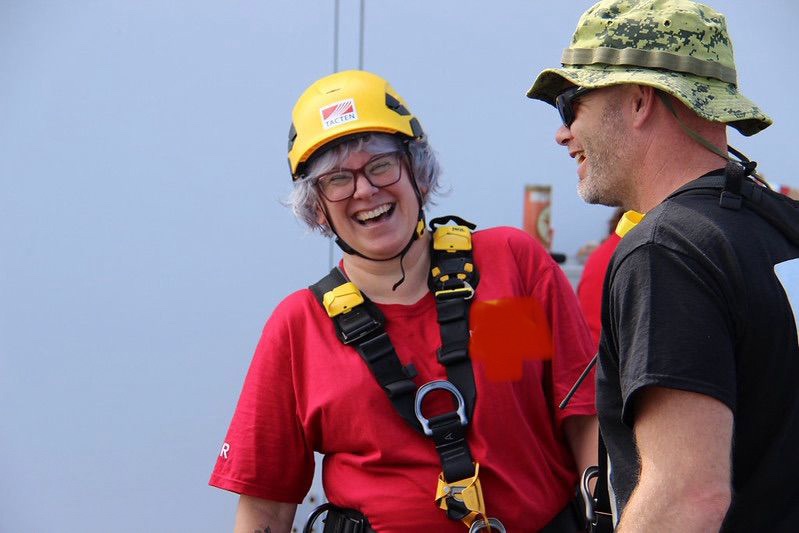
Is she laughing? Yes (Is she scared to death? 100%)
I was at the 23rd story (the roof) of an OFFICE BUILDING. I could see forever everywhere I looked.
The team at Tacten were amazing (all the volunteers were!).
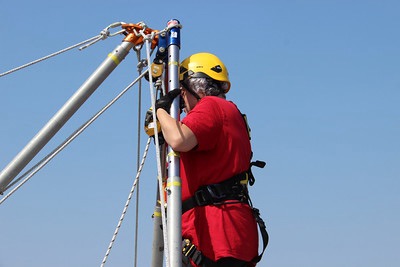
They checked and adjusted my harness, walked me through each step, and got me over to my spot. I was hooked up at the waist and chest.
I was facing inward, and was told to step backwards onto the ledge and get into the brace.
Holding on for dear life.
This is where I questioned my life choices, lol.
Then I remembered WHY I was doing this, and the people who I was doing it for.
So, when they helped me adjust my feet so that my heels were off the ledge, and told me to sit back – I took a deep breath (they gave me so much support!) and said out loud: “This is the hardest part.”
Then I sat back.
Took my first steps down.
The photographer said: “Hey, Amy!”
I looked up.
He suggested the pose.
I never looked down – haha
From there, I started my descent. They said we should enjoy the view…so I enjoyed the reflection in the office building windows!
It was a surreal experience.
Once in a lifetime for me!
A day to remember, and a great fundraising effort by my work colleagues.
Facing one of my fears gave me the opportunity to see what I am capable of, even under a great amount of anxiety.
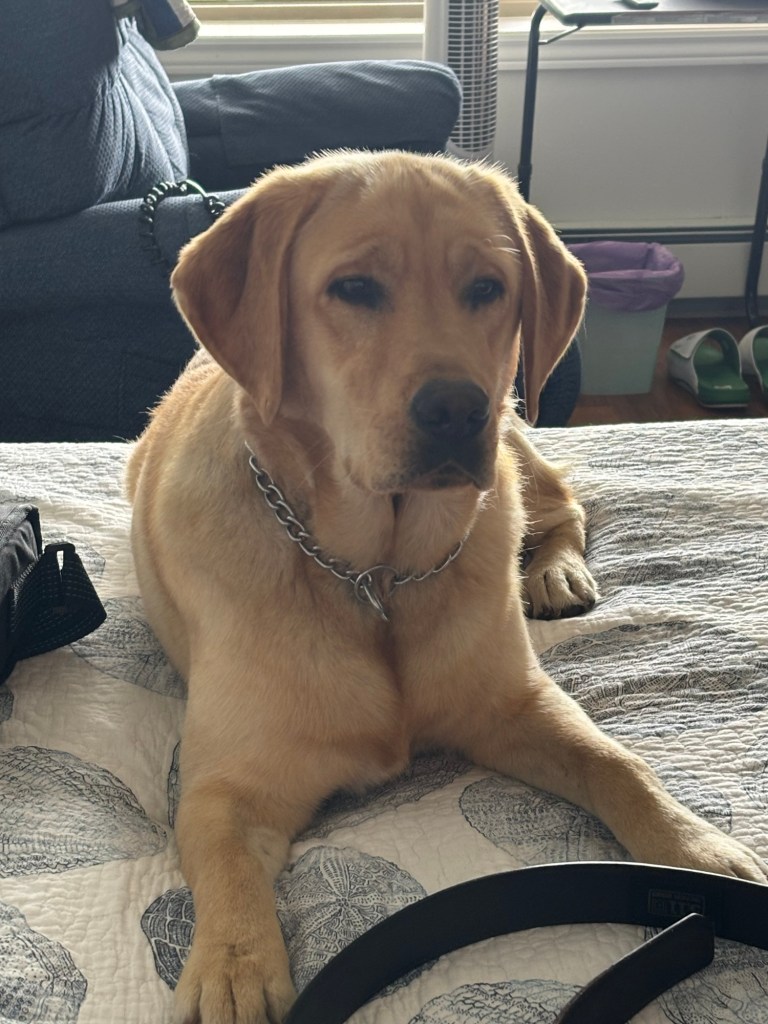
This photo has nothing to do with this post. Yacht is my father’s new service dog, and we are all very happy he is now part of the family.
I’m awake when I should be asleep. Nothing out of the ordinary in this world of perimenopause – just extremely aggravating when a couple of hours ago I came to bed because of how exhausted I was.
Things are good, and I have nothing that is keeping me from going to sleep (well, that I know of).
I have settled into my role and stepping into projects.
Diving back into legal tech, and exploring all the options and possibilities.
I take my ingestion of news in pieces, because if I don’t it robs me of the small joys.
I bought a bike, and plan on getting back out there after I get a helmet and water bottle holder (I bought my fiance and I new bike bells for the trails).
I’m finally in a place where I am comfortable with the skin I am in.
Yet, as I yawn while writing this post…sleep eludes me.
So, I think I will make myself a cup of tea and pick up a book, in the hopes that I will be able to put my head down soon and rest.
I have so much more to write, I just need get my thoughts sorted.
For a long time, I was made to feel like I wasn’t smart enough to have good ideas.
If I didn’t have the answer the instant a question was asked, the assumption was that I either didn’t know anything — or hadn’t retained anything I learned in school. That kind of pressure sticks to you. It makes you second‑guess your own thoughts before they even form.
Over time, with guidance and genuinely good leadership, I learned something important: I do have ideas worth sharing — I just need time to process before I speak.
And here’s the thing we don’t talk about enough: In today’s “I need it now” culture, giving someone time to think can feel strange. But without that space, we miss out on perspectives, solutions, and creativity that don’t arrive on a snap‑reaction timeline.
I’ve seen this play out across industries throughout both areas of my career.
I remember my beginnings in the legal world, where you either picked up the phone for an “urgent answer” or you wrote (read: typed) a letter and waited. Not always ideal, but it was how things were done before “electronic mail”.
Back in my IT days, we once had to rig an internet connection together because of provider issues. We sent out a polite request asking folks to use their home internet for anything heavy over the weekend (and I just happened to be on call). Naturally, the office filled up on a Saturday with people pounding that fragile connection. I ended up heading into the office, walking around telling people to go home… or to the library. Yes — I suggested manual brain labour. And yes — I stand by it.
Over the years, I have watched the whole evolution: dial‑up to cable to fibre, giant brick cell phones to BlackBerry to iPhone to everything we have now.
All of that to say: the pace changed — but people didn’t magically become faster thinkers.
All of these experiences and growth taught me something simple but powerful:
Your ideas matter — even if they don’t arrive instantly. Especially if they don’t arrive instantly.
Thoughtfulness is not incompetence.
Processing is not a flaw.
And taking a moment before you speak is not a weakness — it’s a strength.
If you’ve ever been made to feel small for needing time, I hope you share your ideas anyway.
I’ve been dealing with unexpected dental issues that landed me in a dentist’s chair this afternoon. On Tuesday, I saw my family physician about a mix of perimenopause symptoms and a psoriasis flare. I’d also run out of a medication that usually keeps my anxiety at a manageable level.
Between the lack of sleep, the intense anxiety, and the constant urge to claw at my ears, I haven’t felt like myself. I’ve been fighting my inner critic every step of the way.
I’m often amazed by the human brain. It lets me function, carry knowledge, and move through the world — and at the same time, it can work against me. My reactions swing between extremes: snapping into action so I don’t look “incompetent,” or shutting down completely and slipping into flight mode and procrastination.
On the difficult days, it’s not that I don’t know the answer. I do. I know what I know, and I know what I don’t. I just can’t always get the words out of my head and into something that makes sense. I get flustered. I feel small.
Then comes the rebuilding — the urge to prove my worth, to show that I’m capable, to claw my way back to solid ground. All while trying not to let anyone see the struggle underneath.
It always feels like a setback, so I force myself to remember the good things: the great idea I had last week, the lunch with colleagues in the eDiscovery industry, the small wins that remind me I am intelligent, confident, and happy.
These days are exhausting because I’m working so hard not to let those inner demons win.
As I continue to settle into my role, I am having to readjust boundaries and priorities.
I am getting involved more in the day to day, and gaining insight into where bits and pieces of workflows can be replicated to bring efficiencies.
If I haven’t mentioned this before, I will mention it now: I am surrounded by an amazing group of people. I feel fortunate to be able to engage with everyone and “talk shop”, while having fun doing it.
I have been conditioned over the years to be ON all the time. Feeling the need (and sometimes being expected) to answer emails outside of my work hours on things that could wait until the next day, to work on tasks during my free time to “catch up”, and I always found myself watching my phone 24/7.
This is where I struggle right now: the gearing down. I know what is expected of me and what isn’t, but that pull of always being on has been hard to shake. There are days that I find I am feeling “all over the place”.
Having an environment where folks are mindful of a person’s personal time, and how they delegate work is a big shift. It has played a big part in my mental health journey over the past couple of months. My family has noticed, and definitely has the benefit of a much nicer me.
The shift “sideways” has also been a welcome addition to my new workflow. Being able to look at processes, get feedback from all stakeholders, and begin to work on solutions for them has been fulfilling in ways I could not imagine.
There are new avenues I am also exploring with some associations I belong to, and keeping up to date with all things eDiscovery fills my cup.
Has it been hard to shift from being in a working manager role to managing processes? Absolutely – I would by lying if I said otherwise.
Do I overstep sometimes? You bet I do.
I am trying to afford myself the grace of making mistakes during this transition.
With time, I will find my flow.
For now, I know I can lean on those around me to keep me steady.
At the time, I thought it needed to look a certain way — and please don’t ask me what that “way” was, because I genuinely have no clue anymore.
It happened on the night of my March anxiety dump. I stared at my layout and thought: “This is too much. Too busy. I need it to do one thing — speak.”
These moments hit constantly.
Troubleshooting network issues. Wrestling with document formatting. Building workflows. You chase the big problem because you want to deliver the fancy solution.
Then the lightbulb flicks on.
Maybe the issue isn’t buried in code. Maybe the workflow isn’t complex — just cluttered. Maybe the “solution” you’re hunting for out in the wild is sitting right in front of you, waving its arms like, “Hello? Over here?”
When you’re creating workflows, building projects, or explaining solutions, it doesn’t need to be flashy. It needs to make sense. It needs to provide value.
Can you add pizzazz? Sure. But in small, digestible, pizzazz‑y bites.
Because here’s the truth: change isn’t easy.
Overload people with too much information and their eyes glaze over. You’ve lost them before you’ve even begun.
Now that I’m older (and maybe wiser?), I finally get it.
My fancy‑pants days are over.
Efficiency wins. Clarity wins. And more often than not, simple words land better than technical jargon when someone just wants to know one thing:
Is she thinking? Is she plotting? Does she know anything?
I can tell you two things.
I know what I know. I also know what I don’t know.
Still, there are moments when answers don’t come as quickly as they used to, and those moments shake my confidence. In a world where information is a thumb‑tap away, we expect instant answers. That expectation makes uncertainty feel like failure.
When I first started working, you wrote letters and waited a week or two for a reply. You picked up a desk phone and called someone to resolve an issue. There was time built into the process — time to think, to gather facts, to let an answer settle. It’s no wonder anxiety has risen. We are not given time to work through problems before we respond. We have been conditioned to be “on” all the time.
For years the grind was worn like a badge. I have been through a lot and worked on very difficult projects. I have learned — finally, I hope — that working without living is harmful. Being constantly “on” is what makes me stumble: anxiety rises, my thoughts tangle, and I don’t give myself the space to really consider what I’m being asked.
Now that I am seasoned (read: over 50, lol), there are times when my train of thought simply disappears. It’s gone, and panic follows. I worry they will think I’m not knowledgeable, that they will doubt my expertise.
Then the voice in my head: AM I LOSING MY MIND? (Reader, she was not losing her mind.)
The key for me is to pause. Pausing lets the crossed wires uncross themselves. It reminds me that I do know things, and that clarity often comes after rest. To be responsive and helpful I need recovery time.
Boundaries about when I am available are now at the top of my list. I carve out the first part of my morning to review new emails and requests from the day before. That quiet window helps me prioritize what needs attention and what can wait. I have also blocked out my lunch hour. It’s making a big difference: I’m not fighting to stay awake at 3 p.m., and I’m more able to listen — really listen — instead of rushing to respond.
Slowing down doesn’t mean falling behind. It means giving myself the time to think, recover, and show up with the clarity my work deserves.
It has been part of my life for as long as I can remember.
In elementary school, when a new reader arrived at the start of the year, I would hide it in my room and read long after lights-out. In sixth grade, summer meant trips to the base library every other day, returning with six or seven small novellas and devouring them all.
When my daughter was born, I began buying books for her and raising her to love the library and choose her own stories. I’ve always been a tactile reader who loved the feel and smell of a new book. The Kindle changed that habit by letting me carry a whole shelf in one device, and I eagerly gobbled up everything I could.
Coursework, however, felt different. It lacked the plot and escape of fiction and required a different kind of attention. Learning—especially subjects I’d struggled with as a child, like math—became a deliberate journey. In IT, reading is unavoidable; the field is intricate and data-driven, and while some concepts came naturally, others required steady, piece-by-piece effort.
Earning my ACEDS certification meant practicing daily and taking the material in manageable chunks. My Legal Project Management course was fascinating and at times intense.
I usually learn best by writing.
Sometimes that means handwriting notes; other times it’s dumping my thoughts into a Word document until the ideas settle.
This will often get me through the brain freeze, unless the freeze is caused by Carl the Saboteur telling me I am NOT smart enough to be reading *insert smart material here*.
Carl is an ass, but most times he is there for a reason, even though there are times I do not know what the reason is.
It’s in those moments that I need to sit with someone who I can legit word vomit to and work through that doubt with.
Then there are times where I just have to stop, and it becomes a “tomorrow problem”.
I mean, your brain needs a break too.
If you wouldn’t mind, I would love to hear your tricks and tips for getting through the brain freeze when reading/studying, so please share in the comments and we can all make our own cheat sheets.
The one thing that has always thrown me into full throttle overthinking is when I was starting a new journey.
No matter what it was: a course, a position, a life event, I would overthink that thing into OBLIVION. If someone said “Have you thought about….” And I would stop them right there. I would ask the question: “You mean *insert thing here*?”
If I do not overthink it at the beginning, it is coming. Could be in the middle, or my favourite, AT THE END.
Once something is over, look out. I will chew on that until it bleeds.
While you may be thinking most of this is great, because I have considered every angle (I mean sure, I most likely have), I am going to tell you a secret…
This is what holds me back. It will stop me from moving forward because I will hyper focus on the things that could possibly go wrong.
See what happens here? It’s a vicious cycle.
When I overcome a hurdle, it seems like I end up choosing a different, very curvy road. A road I know has been well travelled. A road that I now need to look at through a very uber science-y telescope.
Sometimes I will write things down and read them over to see if I am going down an unnecessary path to insanity.
Other times I will write to someone I trust, and genuinely ask them if I am crazy (they usually say no…except the smartass ones, they pile onto why I am crazy and then we laugh and I feel better).
There is the three deep breaths rule I have been following. If I find my heart start to race and my attention all over in different directions, I stop and take three deep breaths.
It restarts my thought process.
Getting up and “doing some laps” around the office helps, especially if it leads to someone you can word vomit with.
Finding that confidence, that nugget of “frig yeah I know this” is not always easy.
I will often remind myself that if I didn’t know what I was doing, I would be unemployed, and the fact that I HAVE been employed since my teenage years (minus childbirth and my mental breakdown) really speaks for itself.
So, if you have been in the bucket of self doubt, you’re not alone. Look around you, the bucket is definitely not empty.